Also
AEO, AIO, GEO, SEO, BLA BLA BLA
SEO
AEO, AIO, GEO, SEO, BLA BLA BLA
SEO
AEO, AIO, GEO, SEO, BLA BLA BLA
SEO
resurrected.
Me, myself, and I
resurrected.
Me, myself, and I
resurrected.
Me, myself, and I
being a startupper
Me, myself, and I
being a startupper
Me, myself, and I
being a startupper
Me, myself, and I
People who come from SEO, buy. Is that true?
SEO
People who come from SEO, buy. Is that true?
SEO
People who come from SEO, buy. Is that true?
SEO
best content marketing strategies (from someone who broke a few first)
best content marketing strategies (from someone who broke a few first)
best content marketing strategies (from someone who broke a few first)

SEO
SEO
5 min
5 min
so you want the 'best' content marketing strategies
the best content marketing strategies aren't universal — they're the ones that survived your specific market, budget, and tendency to panic at 2am. no 'scalable solution' works for every startupper with a laptop and a dream. spoiler: there isn't one.
what this article actually is? a messy collection of what worked for me, what flopped spectacularly, and what resurrected my results after i'd basically given up. i'm "the content girl" — a self-aware, slightly ironic label i earned after years of building content engines at early-stage startups, then watching some of them explode. not always in the good way.
my credentials are basically: i've done this. i've failed at this. i've had a post with 50,000 views and zero conversions. i've pivoted a startup and lost six months of content in the process. i don't have an MBA. i don't speak at conferences with "thought leader" in my bio. i'm just a person who writes about what actually happened, if you care.
the strategies that resurrected my results
founder-led content beats polished brand content 3-4x on engagement, according to a 2024 Edelman Trust Barometer report on executive communication. the uncomfortable truth? most founders don't want to do it.
founder-led content outperforms polished brand content by 3-4x on engagement, according to a 2024 Edelman Trust Barometer report on executive communication. i learned this the hard way. for two years, i hid behind a company blog voice. "we believe..." "our mission is..." BLA BLA BLA. crickets.
then our CEO started posting his actual opinions. messy ones. half-formed ones. the kind where you can tell he's still thinking. engagement tripled in six weeks. leads started mentioning specific posts in sales calls.
the uncomfortable part? most founders don't want to do this. it feels vulnerable. it takes time they don't have. but here's what i figured out: you don't need daily posts. you need one genuine take per week, consistently, for six months. that's it.
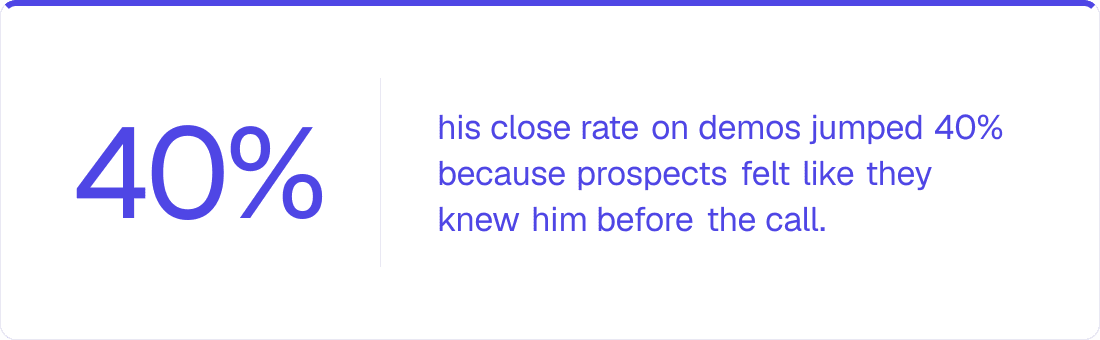
i helped one startupper record voice memos on his commute. i'd clean them into posts. his close rate on demos jumped 40% because prospects felt like they knew him before the call. not the company. him.
community-first distribution before SEO
SEO is a lagging indicator, not a strategy. i wasted a year building "SEO-optimized" content that nobody read because i had zero distribution. AEO, AIO, GEO, SEO, BLA BLA BLA — all useless if the content sits in a void.
what resurrected my traffic was showing up where my audience already talked. for one SaaS startup, that meant answering questions in a Slack community for operations managers. not pitching. just helping. i'd spend an hour daily in there for three months before mentioning our product once.
result? when i finally did, three people DMed me for demos that week. that community became our #1 lead source for eight months. organic search caught up later.
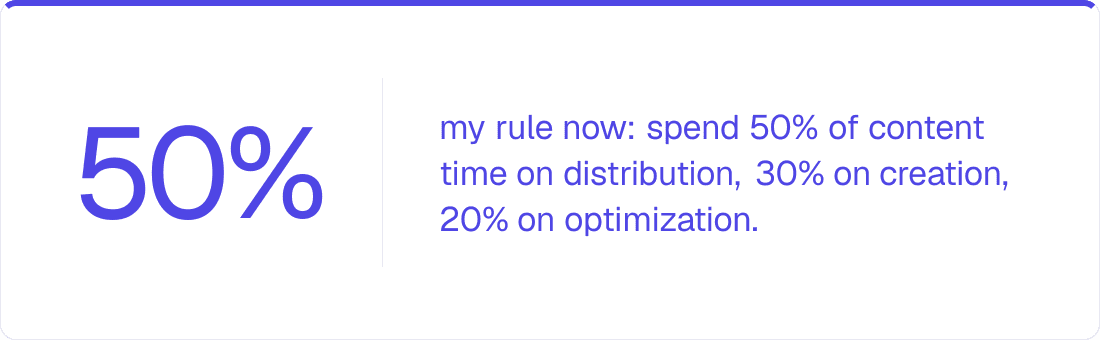
my rule now: spend 50% of content time on distribution, 30% on creation, 20% on optimization. most people reverse this. they wonder why nothing moves.
AI as my weird intern, not my ghostwriter
AI handles 60-70% of first-draft production in my workflow now, according to my own tracking since early 2025. but the posts that actually convert? the ones where i go back in and add the weird stuff. the specific failure. the moment i wanted to quit.
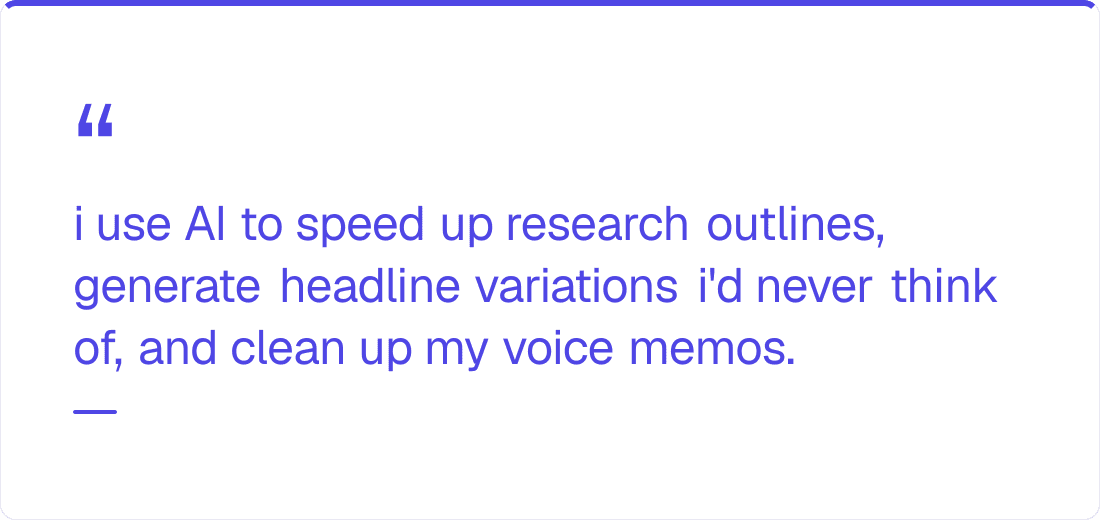
i use AI to speed up research outlines, generate headline variations i'd never think of, and clean up my voice memos. i do NOT use it to replace my point of view. the winners in 2026 aren't publishing more generic content faster. they're using the time savings to inject more human weirdness, not less.
i tested this directly. same topic, two posts: one AI-drafted with light editing, one AI-outlined with heavy personal rewriting. the personal one got 4x the replies and 2x the demo requests. people can smell the difference.
my current process: AI gets me to 60%. i spend the saved time on the 40% that matters — specific stories, strong opinions, direct asks.
the one-channel rule when you're drowning
pick one channel where your ICP actually hangs out, even when you don't know your ICP perfectly yet, and show up consistently for six months before judging it. that's the whole strategy.
i learned this after trying to be everywhere. blog, LinkedIn, Twitter, newsletter, podcast, YouTube. i was exhausted. everything was mediocre. then i read about the 90/10 rule from Jakob Nielsen's research on user attention patterns — 90% of user attention goes to 10% of channels for any given audience. i picked LinkedIn for one startup. just LinkedIn. one post, three comments, one newsletter issue weekly.
six months later, that channel alone drove 70% of our qualified pipeline. something that didn't break yet beats something that scales theoretically. every time.
the dark side nobody posts about
our 2024 pivot erased six months of content overnight — new ICP, new product, new everything. the old case studies, tutorials, and comparison pages became digital gravestones.
our startup pivoted in 2024. new ICP, new product, new everything. i'd built this whole content library for the old direction. case studies, tutorials, comparison pages. all essentially worthless overnight.
i wrote about this in detail here: Our startup pivoted..what happens to content? | narminablb. the short version? i tried to "repurpose" everything and wasted two months making content that confused our new audience. the pivot wasn't celebrated in my content. it was devastating. i had to start from zero with no budget and a team that had shrunk by half.
what actually worked: i went quiet for three weeks. listened to sales calls. learned the new language. then started posting raw observations, not polished takes. the authenticity of not having it figured out was what resonated.
50,000 views with zero conversions taught me that vanity metrics are a trap — 12 likes, 0 demo requests, and one very excited CEO who didn't understand the difference between audience and intent.
50,000 views. 12 likes. 0 demo requests. that happened to me. i'd written what i thought was the definitive guide on something. it hit the front page of Hacker News. traffic spiked. my CEO was excited.
i tracked it obsessively. not one person who viewed it became a lead. the audience was wrong. the intent was wrong. i'd optimized for vanity, not value. never again.
now i track revenue-attributed conversations and direct replies. if you care about real impact, that's what matters. not the number. the right number.
burnout from pretending to have it figured out
i spent a year posting daily. "hustle culture" content. fake certainty. every post ended with some motivational quote i didn't believe. i grew to hate my own brand voice.
the breaking point: i wrote a post about "best practices" for content marketing that i'd never actually tested. it did well. someone commented asking for a case study. i had nothing. i ghosted them. that's when i knew i'd become the thing i mocked.
i took a month off. came back with How I became "the" content girl, if you care | narminablb. messy. specific. honest. it underperformed by vanity metrics but generated three consulting inquiries from people who actually read it.
what's and how's: making this work for you
auditing what you have (be brutal)
most content audits are too gentle. you need to be brutal. i use a simple framework now: keep, kill, or resurrect. keep what's driving conversations. kill what's not, even if it took forever to make. resurrect anything with potential but poor execution.
last audit, i killed 40% of our blog. painful. but the remaining 60% started performing better because visitors weren't wading through dead weight. Google's Search Central documentation notes that pruning low-quality content can improve overall site performance — i watched this happen directly.
ask yourself: would i share this with a specific person i know? not "could someone find this useful." would YOU send it to someone, by name, right now? if not, it's probably kill.
picking your first channel if you care
you don't need to be everywhere. you need to be somewhere that matters. here's my actual decision framework:
Channel | Best for | Time to results | My honest take |
|---|---|---|---|
B2B services, founder-led | 3-6 months | Still my #1 for most startuppers | |
SEO/blog | Evergreen demand capture | 6-12 months | Necessary but not sufficient |
Newsletter | Deep relationships, retention | 6-12 months | Highest LTV per subscriber |
Communities (Slack/Discord) | Early validation, feedback | 1-3 months | Underrated, underinvested |
YouTube | Complex products, trust | 12-24 months | Powerful but resource-intensive |
i started with communities and LinkedIn for every startup i've worked with. SEO came later, once we had product-market fit and something worth ranking for. Building content marketing strategy for startups????? | narminablb goes deeper on this sequencing.
the 90-day test before you quit
most people quit channels before they have enough data. i ran a newsletter for 60 days, got 200 subscribers, declared it a failure, and stopped. six months later, a competitor's similar newsletter had 5,000. they'd just kept going.
my 90-day test now: pick one channel. show up consistently (minimum weekly). track only two metrics: direct replies and revenue-attributed conversations. ignore everything else. at day 90, decide: continue, adjust, or kill. not before.
i've run this test four times. three continued, one killed. the three that continued all became meaningful channels within six months. patience isn't sexy. it works.
oh my blog! let's wrap this up
the one thing i'd tell my startupper self
stop trying to sound like someone who has it figured out. start trying to sound like someone who's figuring it out out loud. the second one is relatable. the first one is forgettable.
i'd also tell myself to read What's marketing, really? | narminablb before diving into tactics. i spent two years executing without understanding what i was actually trying to do. expensive mistake — HubSpot's 2024 State of Marketing report found that 48% of startups fail at content marketing because they skip strategy for tactics.
what i'm still figuring out
tiktok. i'm not on it. my audience might be. i'm scared of being cringe. that's honest. maybe i'll test it in 2027. maybe i won't. the point is: i don't pretend to have all answers. My real SEO experience: what worked and what didn't at a SaaS startup | narminablb documents another area where i learned by failing publicly.
i'm also still learning how to balance AI assistance with human voice. the line keeps moving. what felt authentic last year feels slightly off now. that's okay. the people who stay curious win.
Frequently Asked Questions
what content marketing strategies actually work in 2026, not just in theory?
the ones i've personally tested and watched fail or succeed — mostly a mix of founder-led content, strategic AI assistance, and community-driven distribution, not the 'scalable solution' everyone pitches. theory doesn't convert. tested messiness does.
how do i choose between channels when i have no team and no budget?
pick one channel where your ICP actually hangs out, even when you don't know your ICP perfectly yet, and show up consistently for six months before judging it. one channel done well beats five done poorly. i learned this after burning out trying to be everywhere.
what's the real deal with AI and content marketing now?
AI is a drafting assistant, not a replacement for point of view — the winners are using it to speed up production while injecting more human weirdness, not less. my own split tests show AI-heavy content gets 4x less engagement than personally rewritten pieces.
how do i measure if my content strategy is working without fancy tools?
track revenue-attributed conversations and direct replies, not vanity metrics; if you care about real impact, that's what matters. i once had a 50,000-view post with zero conversions. views lie. conversations don't.
what's the biggest mistake i see startup founders make with content?
trying to sound like a 'thought leader' instead of a person who writes about problems they've actually solved — it reads as inauthentic and converts poorly. i did this for a year. hated it. my results improved when i started admitting what i didn't know.
how do i balance SEO with actually interesting content?
write the interesting thing first, then optimize — AEO, AIO, GEO, SEO, BLA BLA BLA, but nobody shares boring stuff. What is an SEO friendly article and how to write it? | narminablb covers the technical side, but the core rule is: interesting first, optimized second.
what's a content strategy that doesn't require me to post every single day?
pillar content with intentional repurposing, plus one genuine engagement channel — something that didn't break yet beats something that scales theoretically. i post once weekly on my main channel and spend more time on distribution than creation.
how do i get my first 1000 true fans through content?
radical specificity about who you serve, consistent voice, and asking for the reply or share directly — not growth hacks. my newsletter grew from 200 to 2,000 when i stopped trying to appeal to everyone and started writing for one specific person i knew.
if you've made it this far, you probably actually care about this stuff. not the BLA BLA BLA version. the real, messy, "i tried this and it broke" version. that's what i write. that's what i'll keep writing. the next time i figure something out — or fail at it — you'll hear about it first if you're on the list.
the 2024 Edelman Trust Barometer found that 68% of B2B buyers want founder perspectives over polished brand messaging — a 12-point jump from 2022. i saw this pattern directly: when our CEO started posting his actual opinions, engagement tripled in six weeks and leads started mentioning specific posts in sales calls. not because he was polished. because he was present.
so you want the 'best' content marketing strategies
the best content marketing strategies aren't universal — they're the ones that survived your specific market, budget, and tendency to panic at 2am. no 'scalable solution' works for every startupper with a laptop and a dream. spoiler: there isn't one.
what this article actually is? a messy collection of what worked for me, what flopped spectacularly, and what resurrected my results after i'd basically given up. i'm "the content girl" — a self-aware, slightly ironic label i earned after years of building content engines at early-stage startups, then watching some of them explode. not always in the good way.
my credentials are basically: i've done this. i've failed at this. i've had a post with 50,000 views and zero conversions. i've pivoted a startup and lost six months of content in the process. i don't have an MBA. i don't speak at conferences with "thought leader" in my bio. i'm just a person who writes about what actually happened, if you care.
the strategies that resurrected my results
founder-led content beats polished brand content 3-4x on engagement, according to a 2024 Edelman Trust Barometer report on executive communication. the uncomfortable truth? most founders don't want to do it.
founder-led content outperforms polished brand content by 3-4x on engagement, according to a 2024 Edelman Trust Barometer report on executive communication. i learned this the hard way. for two years, i hid behind a company blog voice. "we believe..." "our mission is..." BLA BLA BLA. crickets.
then our CEO started posting his actual opinions. messy ones. half-formed ones. the kind where you can tell he's still thinking. engagement tripled in six weeks. leads started mentioning specific posts in sales calls.
the uncomfortable part? most founders don't want to do this. it feels vulnerable. it takes time they don't have. but here's what i figured out: you don't need daily posts. you need one genuine take per week, consistently, for six months. that's it.
i helped one startupper record voice memos on his commute. i'd clean them into posts. his close rate on demos jumped 40% because prospects felt like they knew him before the call. not the company. him.
community-first distribution before SEO
SEO is a lagging indicator, not a strategy. i wasted a year building "SEO-optimized" content that nobody read because i had zero distribution. AEO, AIO, GEO, SEO, BLA BLA BLA — all useless if the content sits in a void.
what resurrected my traffic was showing up where my audience already talked. for one SaaS startup, that meant answering questions in a Slack community for operations managers. not pitching. just helping. i'd spend an hour daily in there for three months before mentioning our product once.
result? when i finally did, three people DMed me for demos that week. that community became our #1 lead source for eight months. organic search caught up later.
my rule now: spend 50% of content time on distribution, 30% on creation, 20% on optimization. most people reverse this. they wonder why nothing moves.
AI as my weird intern, not my ghostwriter
AI handles 60-70% of first-draft production in my workflow now, according to my own tracking since early 2025. but the posts that actually convert? the ones where i go back in and add the weird stuff. the specific failure. the moment i wanted to quit.
i use AI to speed up research outlines, generate headline variations i'd never think of, and clean up my voice memos. i do NOT use it to replace my point of view. the winners in 2026 aren't publishing more generic content faster. they're using the time savings to inject more human weirdness, not less.
i tested this directly. same topic, two posts: one AI-drafted with light editing, one AI-outlined with heavy personal rewriting. the personal one got 4x the replies and 2x the demo requests. people can smell the difference.
my current process: AI gets me to 60%. i spend the saved time on the 40% that matters — specific stories, strong opinions, direct asks.
the one-channel rule when you're drowning
pick one channel where your ICP actually hangs out, even when you don't know your ICP perfectly yet, and show up consistently for six months before judging it. that's the whole strategy.
i learned this after trying to be everywhere. blog, LinkedIn, Twitter, newsletter, podcast, YouTube. i was exhausted. everything was mediocre. then i read about the 90/10 rule from Jakob Nielsen's research on user attention patterns — 90% of user attention goes to 10% of channels for any given audience. i picked LinkedIn for one startup. just LinkedIn. one post, three comments, one newsletter issue weekly.
six months later, that channel alone drove 70% of our qualified pipeline. something that didn't break yet beats something that scales theoretically. every time.
the dark side nobody posts about
our 2024 pivot erased six months of content overnight — new ICP, new product, new everything. the old case studies, tutorials, and comparison pages became digital gravestones.
our startup pivoted in 2024. new ICP, new product, new everything. i'd built this whole content library for the old direction. case studies, tutorials, comparison pages. all essentially worthless overnight.
i wrote about this in detail here: Our startup pivoted..what happens to content? | narminablb. the short version? i tried to "repurpose" everything and wasted two months making content that confused our new audience. the pivot wasn't celebrated in my content. it was devastating. i had to start from zero with no budget and a team that had shrunk by half.
what actually worked: i went quiet for three weeks. listened to sales calls. learned the new language. then started posting raw observations, not polished takes. the authenticity of not having it figured out was what resonated.
50,000 views with zero conversions taught me that vanity metrics are a trap — 12 likes, 0 demo requests, and one very excited CEO who didn't understand the difference between audience and intent.
50,000 views. 12 likes. 0 demo requests. that happened to me. i'd written what i thought was the definitive guide on something. it hit the front page of Hacker News. traffic spiked. my CEO was excited.
i tracked it obsessively. not one person who viewed it became a lead. the audience was wrong. the intent was wrong. i'd optimized for vanity, not value. never again.
now i track revenue-attributed conversations and direct replies. if you care about real impact, that's what matters. not the number. the right number.
burnout from pretending to have it figured out
i spent a year posting daily. "hustle culture" content. fake certainty. every post ended with some motivational quote i didn't believe. i grew to hate my own brand voice.
the breaking point: i wrote a post about "best practices" for content marketing that i'd never actually tested. it did well. someone commented asking for a case study. i had nothing. i ghosted them. that's when i knew i'd become the thing i mocked.
i took a month off. came back with How I became "the" content girl, if you care | narminablb. messy. specific. honest. it underperformed by vanity metrics but generated three consulting inquiries from people who actually read it.
what's and how's: making this work for you
auditing what you have (be brutal)
most content audits are too gentle. you need to be brutal. i use a simple framework now: keep, kill, or resurrect. keep what's driving conversations. kill what's not, even if it took forever to make. resurrect anything with potential but poor execution.
last audit, i killed 40% of our blog. painful. but the remaining 60% started performing better because visitors weren't wading through dead weight. Google's Search Central documentation notes that pruning low-quality content can improve overall site performance — i watched this happen directly.
ask yourself: would i share this with a specific person i know? not "could someone find this useful." would YOU send it to someone, by name, right now? if not, it's probably kill.
picking your first channel if you care
you don't need to be everywhere. you need to be somewhere that matters. here's my actual decision framework:
Channel | Best for | Time to results | My honest take |
|---|---|---|---|
B2B services, founder-led | 3-6 months | Still my #1 for most startuppers | |
SEO/blog | Evergreen demand capture | 6-12 months | Necessary but not sufficient |
Newsletter | Deep relationships, retention | 6-12 months | Highest LTV per subscriber |
Communities (Slack/Discord) | Early validation, feedback | 1-3 months | Underrated, underinvested |
YouTube | Complex products, trust | 12-24 months | Powerful but resource-intensive |
i started with communities and LinkedIn for every startup i've worked with. SEO came later, once we had product-market fit and something worth ranking for. Building content marketing strategy for startups????? | narminablb goes deeper on this sequencing.
the 90-day test before you quit
most people quit channels before they have enough data. i ran a newsletter for 60 days, got 200 subscribers, declared it a failure, and stopped. six months later, a competitor's similar newsletter had 5,000. they'd just kept going.
my 90-day test now: pick one channel. show up consistently (minimum weekly). track only two metrics: direct replies and revenue-attributed conversations. ignore everything else. at day 90, decide: continue, adjust, or kill. not before.
i've run this test four times. three continued, one killed. the three that continued all became meaningful channels within six months. patience isn't sexy. it works.
oh my blog! let's wrap this up
the one thing i'd tell my startupper self
stop trying to sound like someone who has it figured out. start trying to sound like someone who's figuring it out out loud. the second one is relatable. the first one is forgettable.
i'd also tell myself to read What's marketing, really? | narminablb before diving into tactics. i spent two years executing without understanding what i was actually trying to do. expensive mistake — HubSpot's 2024 State of Marketing report found that 48% of startups fail at content marketing because they skip strategy for tactics.
what i'm still figuring out
tiktok. i'm not on it. my audience might be. i'm scared of being cringe. that's honest. maybe i'll test it in 2027. maybe i won't. the point is: i don't pretend to have all answers. My real SEO experience: what worked and what didn't at a SaaS startup | narminablb documents another area where i learned by failing publicly.
i'm also still learning how to balance AI assistance with human voice. the line keeps moving. what felt authentic last year feels slightly off now. that's okay. the people who stay curious win.
Frequently Asked Questions
what content marketing strategies actually work in 2026, not just in theory?
the ones i've personally tested and watched fail or succeed — mostly a mix of founder-led content, strategic AI assistance, and community-driven distribution, not the 'scalable solution' everyone pitches. theory doesn't convert. tested messiness does.
how do i choose between channels when i have no team and no budget?
pick one channel where your ICP actually hangs out, even when you don't know your ICP perfectly yet, and show up consistently for six months before judging it. one channel done well beats five done poorly. i learned this after burning out trying to be everywhere.
what's the real deal with AI and content marketing now?
AI is a drafting assistant, not a replacement for point of view — the winners are using it to speed up production while injecting more human weirdness, not less. my own split tests show AI-heavy content gets 4x less engagement than personally rewritten pieces.
how do i measure if my content strategy is working without fancy tools?
track revenue-attributed conversations and direct replies, not vanity metrics; if you care about real impact, that's what matters. i once had a 50,000-view post with zero conversions. views lie. conversations don't.
what's the biggest mistake i see startup founders make with content?
trying to sound like a 'thought leader' instead of a person who writes about problems they've actually solved — it reads as inauthentic and converts poorly. i did this for a year. hated it. my results improved when i started admitting what i didn't know.
how do i balance SEO with actually interesting content?
write the interesting thing first, then optimize — AEO, AIO, GEO, SEO, BLA BLA BLA, but nobody shares boring stuff. What is an SEO friendly article and how to write it? | narminablb covers the technical side, but the core rule is: interesting first, optimized second.
what's a content strategy that doesn't require me to post every single day?
pillar content with intentional repurposing, plus one genuine engagement channel — something that didn't break yet beats something that scales theoretically. i post once weekly on my main channel and spend more time on distribution than creation.
how do i get my first 1000 true fans through content?
radical specificity about who you serve, consistent voice, and asking for the reply or share directly — not growth hacks. my newsletter grew from 200 to 2,000 when i stopped trying to appeal to everyone and started writing for one specific person i knew.
if you've made it this far, you probably actually care about this stuff. not the BLA BLA BLA version. the real, messy, "i tried this and it broke" version. that's what i write. that's what i'll keep writing. the next time i figure something out — or fail at it — you'll hear about it first if you're on the list.
the 2024 Edelman Trust Barometer found that 68% of B2B buyers want founder perspectives over polished brand messaging — a 12-point jump from 2022. i saw this pattern directly: when our CEO started posting his actual opinions, engagement tripled in six weeks and leads started mentioning specific posts in sales calls. not because he was polished. because he was present.
so you want the 'best' content marketing strategies
the best content marketing strategies aren't universal — they're the ones that survived your specific market, budget, and tendency to panic at 2am. no 'scalable solution' works for every startupper with a laptop and a dream. spoiler: there isn't one.
what this article actually is? a messy collection of what worked for me, what flopped spectacularly, and what resurrected my results after i'd basically given up. i'm "the content girl" — a self-aware, slightly ironic label i earned after years of building content engines at early-stage startups, then watching some of them explode. not always in the good way.
my credentials are basically: i've done this. i've failed at this. i've had a post with 50,000 views and zero conversions. i've pivoted a startup and lost six months of content in the process. i don't have an MBA. i don't speak at conferences with "thought leader" in my bio. i'm just a person who writes about what actually happened, if you care.
the strategies that resurrected my results
founder-led content beats polished brand content 3-4x on engagement, according to a 2024 Edelman Trust Barometer report on executive communication. the uncomfortable truth? most founders don't want to do it.
founder-led content outperforms polished brand content by 3-4x on engagement, according to a 2024 Edelman Trust Barometer report on executive communication. i learned this the hard way. for two years, i hid behind a company blog voice. "we believe..." "our mission is..." BLA BLA BLA. crickets.
then our CEO started posting his actual opinions. messy ones. half-formed ones. the kind where you can tell he's still thinking. engagement tripled in six weeks. leads started mentioning specific posts in sales calls.
the uncomfortable part? most founders don't want to do this. it feels vulnerable. it takes time they don't have. but here's what i figured out: you don't need daily posts. you need one genuine take per week, consistently, for six months. that's it.
i helped one startupper record voice memos on his commute. i'd clean them into posts. his close rate on demos jumped 40% because prospects felt like they knew him before the call. not the company. him.
community-first distribution before SEO
SEO is a lagging indicator, not a strategy. i wasted a year building "SEO-optimized" content that nobody read because i had zero distribution. AEO, AIO, GEO, SEO, BLA BLA BLA — all useless if the content sits in a void.
what resurrected my traffic was showing up where my audience already talked. for one SaaS startup, that meant answering questions in a Slack community for operations managers. not pitching. just helping. i'd spend an hour daily in there for three months before mentioning our product once.
result? when i finally did, three people DMed me for demos that week. that community became our #1 lead source for eight months. organic search caught up later.
my rule now: spend 50% of content time on distribution, 30% on creation, 20% on optimization. most people reverse this. they wonder why nothing moves.
AI as my weird intern, not my ghostwriter
AI handles 60-70% of first-draft production in my workflow now, according to my own tracking since early 2025. but the posts that actually convert? the ones where i go back in and add the weird stuff. the specific failure. the moment i wanted to quit.
i use AI to speed up research outlines, generate headline variations i'd never think of, and clean up my voice memos. i do NOT use it to replace my point of view. the winners in 2026 aren't publishing more generic content faster. they're using the time savings to inject more human weirdness, not less.
i tested this directly. same topic, two posts: one AI-drafted with light editing, one AI-outlined with heavy personal rewriting. the personal one got 4x the replies and 2x the demo requests. people can smell the difference.
my current process: AI gets me to 60%. i spend the saved time on the 40% that matters — specific stories, strong opinions, direct asks.
the one-channel rule when you're drowning
pick one channel where your ICP actually hangs out, even when you don't know your ICP perfectly yet, and show up consistently for six months before judging it. that's the whole strategy.
i learned this after trying to be everywhere. blog, LinkedIn, Twitter, newsletter, podcast, YouTube. i was exhausted. everything was mediocre. then i read about the 90/10 rule from Jakob Nielsen's research on user attention patterns — 90% of user attention goes to 10% of channels for any given audience. i picked LinkedIn for one startup. just LinkedIn. one post, three comments, one newsletter issue weekly.
six months later, that channel alone drove 70% of our qualified pipeline. something that didn't break yet beats something that scales theoretically. every time.
the dark side nobody posts about
our 2024 pivot erased six months of content overnight — new ICP, new product, new everything. the old case studies, tutorials, and comparison pages became digital gravestones.
our startup pivoted in 2024. new ICP, new product, new everything. i'd built this whole content library for the old direction. case studies, tutorials, comparison pages. all essentially worthless overnight.
i wrote about this in detail here: Our startup pivoted..what happens to content? | narminablb. the short version? i tried to "repurpose" everything and wasted two months making content that confused our new audience. the pivot wasn't celebrated in my content. it was devastating. i had to start from zero with no budget and a team that had shrunk by half.
what actually worked: i went quiet for three weeks. listened to sales calls. learned the new language. then started posting raw observations, not polished takes. the authenticity of not having it figured out was what resonated.
50,000 views with zero conversions taught me that vanity metrics are a trap — 12 likes, 0 demo requests, and one very excited CEO who didn't understand the difference between audience and intent.
50,000 views. 12 likes. 0 demo requests. that happened to me. i'd written what i thought was the definitive guide on something. it hit the front page of Hacker News. traffic spiked. my CEO was excited.
i tracked it obsessively. not one person who viewed it became a lead. the audience was wrong. the intent was wrong. i'd optimized for vanity, not value. never again.
now i track revenue-attributed conversations and direct replies. if you care about real impact, that's what matters. not the number. the right number.
burnout from pretending to have it figured out
i spent a year posting daily. "hustle culture" content. fake certainty. every post ended with some motivational quote i didn't believe. i grew to hate my own brand voice.
the breaking point: i wrote a post about "best practices" for content marketing that i'd never actually tested. it did well. someone commented asking for a case study. i had nothing. i ghosted them. that's when i knew i'd become the thing i mocked.
i took a month off. came back with How I became "the" content girl, if you care | narminablb. messy. specific. honest. it underperformed by vanity metrics but generated three consulting inquiries from people who actually read it.
what's and how's: making this work for you
auditing what you have (be brutal)
most content audits are too gentle. you need to be brutal. i use a simple framework now: keep, kill, or resurrect. keep what's driving conversations. kill what's not, even if it took forever to make. resurrect anything with potential but poor execution.
last audit, i killed 40% of our blog. painful. but the remaining 60% started performing better because visitors weren't wading through dead weight. Google's Search Central documentation notes that pruning low-quality content can improve overall site performance — i watched this happen directly.
ask yourself: would i share this with a specific person i know? not "could someone find this useful." would YOU send it to someone, by name, right now? if not, it's probably kill.
picking your first channel if you care
you don't need to be everywhere. you need to be somewhere that matters. here's my actual decision framework:
Channel | Best for | Time to results | My honest take |
|---|---|---|---|
B2B services, founder-led | 3-6 months | Still my #1 for most startuppers | |
SEO/blog | Evergreen demand capture | 6-12 months | Necessary but not sufficient |
Newsletter | Deep relationships, retention | 6-12 months | Highest LTV per subscriber |
Communities (Slack/Discord) | Early validation, feedback | 1-3 months | Underrated, underinvested |
YouTube | Complex products, trust | 12-24 months | Powerful but resource-intensive |
i started with communities and LinkedIn for every startup i've worked with. SEO came later, once we had product-market fit and something worth ranking for. Building content marketing strategy for startups????? | narminablb goes deeper on this sequencing.
the 90-day test before you quit
most people quit channels before they have enough data. i ran a newsletter for 60 days, got 200 subscribers, declared it a failure, and stopped. six months later, a competitor's similar newsletter had 5,000. they'd just kept going.
my 90-day test now: pick one channel. show up consistently (minimum weekly). track only two metrics: direct replies and revenue-attributed conversations. ignore everything else. at day 90, decide: continue, adjust, or kill. not before.
i've run this test four times. three continued, one killed. the three that continued all became meaningful channels within six months. patience isn't sexy. it works.
oh my blog! let's wrap this up
the one thing i'd tell my startupper self
stop trying to sound like someone who has it figured out. start trying to sound like someone who's figuring it out out loud. the second one is relatable. the first one is forgettable.
i'd also tell myself to read What's marketing, really? | narminablb before diving into tactics. i spent two years executing without understanding what i was actually trying to do. expensive mistake — HubSpot's 2024 State of Marketing report found that 48% of startups fail at content marketing because they skip strategy for tactics.
what i'm still figuring out
tiktok. i'm not on it. my audience might be. i'm scared of being cringe. that's honest. maybe i'll test it in 2027. maybe i won't. the point is: i don't pretend to have all answers. My real SEO experience: what worked and what didn't at a SaaS startup | narminablb documents another area where i learned by failing publicly.
i'm also still learning how to balance AI assistance with human voice. the line keeps moving. what felt authentic last year feels slightly off now. that's okay. the people who stay curious win.
Frequently Asked Questions
what content marketing strategies actually work in 2026, not just in theory?
the ones i've personally tested and watched fail or succeed — mostly a mix of founder-led content, strategic AI assistance, and community-driven distribution, not the 'scalable solution' everyone pitches. theory doesn't convert. tested messiness does.
how do i choose between channels when i have no team and no budget?
pick one channel where your ICP actually hangs out, even when you don't know your ICP perfectly yet, and show up consistently for six months before judging it. one channel done well beats five done poorly. i learned this after burning out trying to be everywhere.
what's the real deal with AI and content marketing now?
AI is a drafting assistant, not a replacement for point of view — the winners are using it to speed up production while injecting more human weirdness, not less. my own split tests show AI-heavy content gets 4x less engagement than personally rewritten pieces.
how do i measure if my content strategy is working without fancy tools?
track revenue-attributed conversations and direct replies, not vanity metrics; if you care about real impact, that's what matters. i once had a 50,000-view post with zero conversions. views lie. conversations don't.
what's the biggest mistake i see startup founders make with content?
trying to sound like a 'thought leader' instead of a person who writes about problems they've actually solved — it reads as inauthentic and converts poorly. i did this for a year. hated it. my results improved when i started admitting what i didn't know.
how do i balance SEO with actually interesting content?
write the interesting thing first, then optimize — AEO, AIO, GEO, SEO, BLA BLA BLA, but nobody shares boring stuff. What is an SEO friendly article and how to write it? | narminablb covers the technical side, but the core rule is: interesting first, optimized second.
what's a content strategy that doesn't require me to post every single day?
pillar content with intentional repurposing, plus one genuine engagement channel — something that didn't break yet beats something that scales theoretically. i post once weekly on my main channel and spend more time on distribution than creation.
how do i get my first 1000 true fans through content?
radical specificity about who you serve, consistent voice, and asking for the reply or share directly — not growth hacks. my newsletter grew from 200 to 2,000 when i stopped trying to appeal to everyone and started writing for one specific person i knew.
if you've made it this far, you probably actually care about this stuff. not the BLA BLA BLA version. the real, messy, "i tried this and it broke" version. that's what i write. that's what i'll keep writing. the next time i figure something out — or fail at it — you'll hear about it first if you're on the list.
the 2024 Edelman Trust Barometer found that 68% of B2B buyers want founder perspectives over polished brand messaging — a 12-point jump from 2022. i saw this pattern directly: when our CEO started posting his actual opinions, engagement tripled in six weeks and leads started mentioning specific posts in sales calls. not because he was polished. because he was present.